FeatureMAP on synthetic data of mixture-of-Gaussian with linear pattern.
[22]:
import featuremap


import numpy as np
import matplotlib.pyplot as plt
from sklearn.datasets import make_blobs
from sklearn.decomposition import PCA

import warnings
warnings.simplefilter("ignore", category=UserWarning)
warnings.simplefilter("ignore", category=FutureWarning)
warnings.simplefilter("ignore", category=DeprecationWarning)
Data loading
[23]:
def plot_func(emb, label, method):

    x_min, x_max = emb[:, 0].min(), emb[:, 0].max()
    y_min, y_max = emb[:, 1].min(), emb[:, 1].max()

    min_lim = min(x_min - (x_min+x_max)/2, y_min - (y_min+y_max)/2)
    max_lim = max(x_max +(x_min+x_max)/2, y_max+ (y_min+y_max)/2)

    plt.figure(figsize=(10, 7))
    plt.scatter(emb[:, 0], emb[:, 1], c=label, cmap='tab10')
    plt.xlim(min_lim, max_lim)
    plt.ylim(min_lim, max_lim)
    # plt.colorbar()
    plt.xlabel(f'{method} 1')
    plt.ylabel(f'{method} 2')
    plt.title(f'{method} plot')

    plt.show()
[24]:
import numpy as np

def sample_multidimensional_mixture(w, means, covariances, n_samples=1):
    """
    Sample from a mixture of multivariate normal distributions.

    Parameters:
    w (list or np.array): Weights of the mixture components (should sum to 1).
    means (list of np.array): List of mean vectors for each component.
    covariances (list of np.array): List of covariance matrices for each component.
    n_samples (int): Number of samples to generate.

    Returns:
    np.array: Samples drawn from the mixture distribution.
    """
    # Ensure w is a numpy array
    w = np.array(w)

    # Check that the input is valid
    assert len(w) == len(means) == len(covariances), "Lengths of w, means, and covariances must be equal."
    assert np.isclose(np.sum(w), 1), "Weights w must sum to 1."

    # Step 1: Sample indices from the categorical distribution defined by w
    indices = np.random.choice(len(w), size=n_samples, p=w)

    # Step 2: Sample from the multivariate normal distribution corresponding to the selected index
    samples = np.array([np.random.multivariate_normal(means[i], covariances[i]) for i in indices])

    return samples, indices

# Example usage
w = [0.25, 0.25, 0.25, 0.25]  # Weights of the mixture components

# Linear
# Means for each of the 3 components (20-dimensional)
means = [
    np.zeros(20),           # Mean vector for the first component
    np.ones(20) * 1,        # Mean vector for the second component
    np.ones(20) * 2,       # Mean vector for the third component
    np.ones(20) * 3       # Mean vector for the fourth component
]


# Covariance matrices for each of the 3 components (20x20 matrices)
covariances = [
    np.eye(20) * 1,            # Identity matrix as covariance for the first component
    np.eye(20) * 1,       # Scaled identity matrix for the second component
    np.eye(20) * 1,        # Scaled identity matrix for the third component
     np.eye(20) * 1        # Scaled identity matrix for the third component
]

n_samples = 3000  # Number of samples to generate

samples, indices = sample_multidimensional_mixture(w, means, covariances, n_samples)

print(indices[:10])  # Print the indices of the first 10 samples

data = samples
data_pseudotime = np.array(indices)
[1 3 2 3 1 1 2 2 0 2]
[25]:
# statistics of data_pseudotime
import collections
counter=collections.Counter(data_pseudotime)
print(counter)
Counter({2: 787, 3: 744, 1: 743, 0: 726})
Visualize the data distribution.
[26]:
import numpy as np
# import pca
from sklearn.decomposition import PCA

# plot the data by PCA
pca = PCA(n_components=2)
X_pca = pca.fit_transform(data)

x_min, x_max = X_pca[:, 0].min() - 1, X_pca[:, 0].max() + 1
y_min, y_max = X_pca[:, 1].min() - 1, X_pca[:, 1].max() + 1

min_lim = min(x_min, y_min)
max_lim = max(x_max, y_max)


# contour plot of the data
import numpy as np
import matplotlib.pyplot as plt
from sklearn.neighbors import KernelDensity

# Create a grid of points
x = np.linspace(min_lim, max_lim, 100)
y = np.linspace(min_lim, max_lim, 100)
X, Y = np.meshgrid(x, y)
# Stack the grid points to create a 2D input for the KDE model
xy = np.vstack([X.ravel(), Y.ravel()]).T

# Fit a KDE model to the data
kde = KernelDensity(bandwidth=0.5)
kde.fit(X_pca)

# Evaluate the KDE model on the grid
Z = np.exp(kde.score_samples(xy))
Z = Z.reshape(X.shape)

# Plot the contour plot
plt.figure(figsize=(10, 7))
# plt.contourf(X, Y, Z, cmap='Blues')
plt.contourf(X, Y, Z,levels=15, cmap='Blues',linewidths=0.5, )
# Add lines to mark level boundaries
contour_lines = plt.contour(X, Y, Z, levels=15, colors='blue', linewidths=0.5)

# plt.colorbar()
# plt.scatter(X_pca[:, 0], X_pca[:, 1], c=data_pseudotime, cmap='tab10')
plt.xlim(min_lim, max_lim)
plt.ylim(min_lim, max_lim)
plt.xlabel('First principal component')
plt.ylabel('Second principal component')
plt.title('Contour plot of the data')
plt.show()
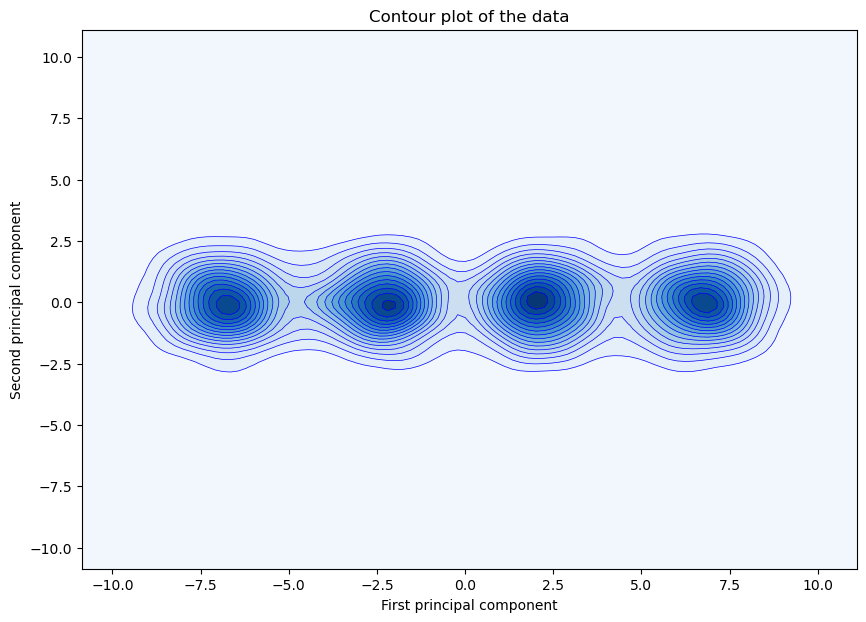
FeatureMAP to visualize the data.
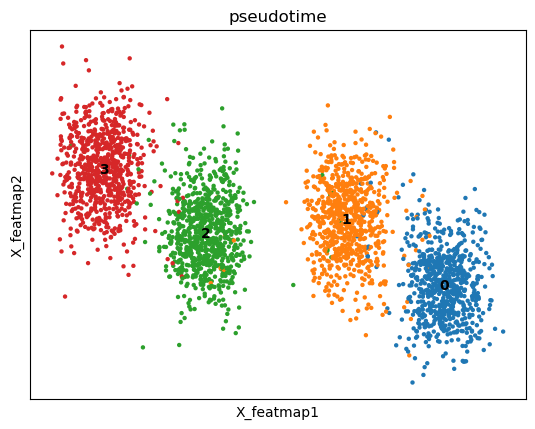
FeatureMAP expression embedding.
[27]:
from featuremap.featuremap_ import _preprocess_data

emb_svd, vh = _preprocess_data(data)

emb_featuremap = featuremap.FeatureMAP(
                    n_neighbors=30,
                    min_dist=0.3,
                    random_state=42,
                    n_epochs=400,
                    output_variation=False,
                    feat_gauge_coefficient=2,
                    verbose=True,
                    ).fit(emb_svd)
FeatureMAP(feat_gauge_coefficient=2, min_dist=0.3, n_epochs=400, random_state=42, verbose=True)
Mon Feb 10 14:26:59 2025 Construct fuzzy simplicial set
Mon Feb 10 14:26:59 2025 Finding Nearest Neighbors
Mon Feb 10 14:26:59 2025 Building RP forest with 8 trees
Mon Feb 10 14:26:59 2025 NN descent for 12 iterations
         1  /  12
         2  /  12
         3  /  12
        Stopping threshold met -- exiting after 3 iterations
Mon Feb 10 14:26:59 2025 Finished Nearest Neighbor Search
Mon Feb 10 14:26:59 2025 Construct embedding
Mon Feb 10 14:26:59 2025 Computing tangent space
Mon Feb 10 14:27:01 2025 Local SVD time is 2.148959159851074
Mon Feb 10 14:27:01 2025Applying graph convolution for 5 iterations...
Mon Feb 10 14:27:02 2025Graph convolution completed in 0.65 seconds
Mon Feb 10 14:27:02 2025 Tangent_space_approximation time is 2.8188211917877197
k is 10
Mon Feb 10 14:27:14 2025 Tangent space embedding
Mon Feb 10 14:27:14 2025 Start optimizing layout
Epochs completed: 100%| ██████████ 400/400 [00:19]
Mon Feb 10 14:27:34 2025 Optimize layout time is 19.85165810585022
Mon Feb 10 14:27:34 2025 Finished embedding
[28]:
from featuremap import features
import importlib
importlib.reload(features)

adata = features.create_adata(X=data, emb_featuremap=emb_featuremap)

# adata.var_names = mnist.data.columns.to_list()

adata.obsm['X_svd'] = emb_svd
adata.varm['svd_vh'] = vh.T


adata.obsm['X_featmap'] = emb_featuremap.embedding_
adata.obs['pseudotime'] = data_pseudotime
adata.obs['pseudotime'] = adata.obs['pseudotime'].astype(str)

# adata.obsm['X_umap'] = emb_umap
import scanpy as sc
sc.pl.embedding(adata, basis='X_featmap', color='pseudotime', legend_loc='on data')
mu is not added to adata
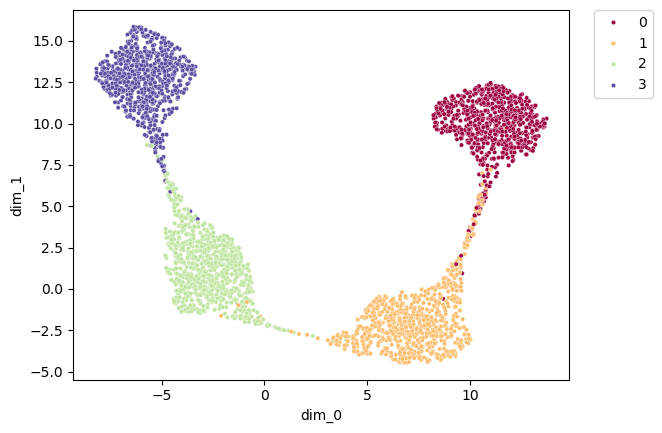
FeatureMAP variation embedding.
[29]:
emb_featuremap_v = featuremap.FeatureMAP(
                    n_neighbors=30,
                    random_state=42,
                    output_variation=True,
                    n_epochs=400,
                    ).fit(emb_svd)

adata.obsm["X_featmap_v"] = emb_featuremap_v.embedding_

adata.obsm['variation_pc'] = emb_featuremap_v._featuremap_kwds['variation_pc']


import seaborn as sns
import matplotlib.pyplot as plt
import pandas as pd
plt.figure(dpi=100)

embedding_df = pd.DataFrame(adata.obsm["X_featmap_v"], index=adata.obs_names, columns=['dim_0', 'dim_1'])
embedding_df['pseudotime'] = data_pseudotime
sns.scatterplot(x='dim_0',y='dim_1', hue='pseudotime', data=embedding_df, palette='Spectral', s=10)
plt.legend(bbox_to_anchor=(1.05, 1), loc=2, borderaxespad=0.)
[29]:
<matplotlib.legend.Legend at 0x7f939244aa30>
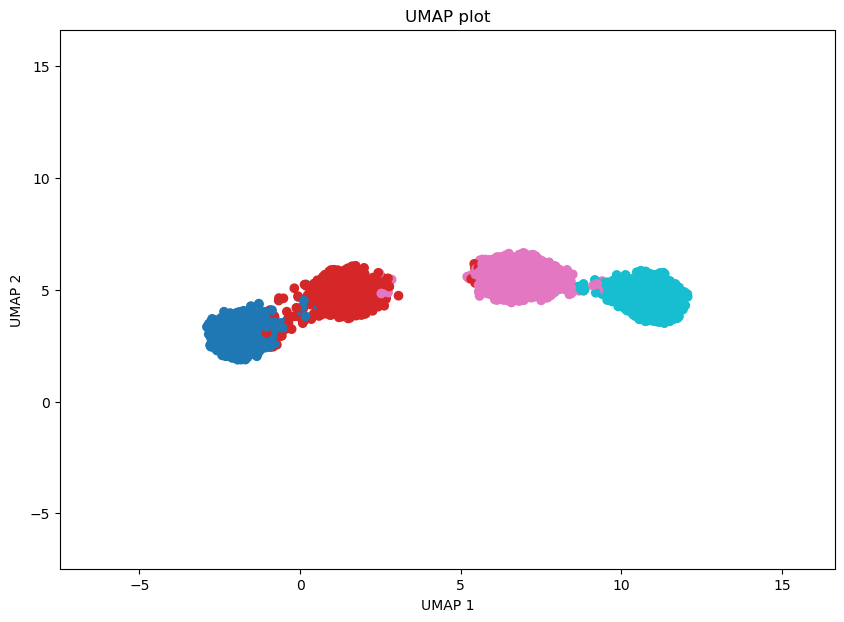
Benchmark with other DR methods
[30]:
# UMAP plot
import umap
emb_umap = umap.UMAP().fit_transform(data)

adata.obsm['X_umap'] = emb_umap

# plot the data by UMAP
plot_func(emb_umap, data_pseudotime, 'UMAP')
[31]:
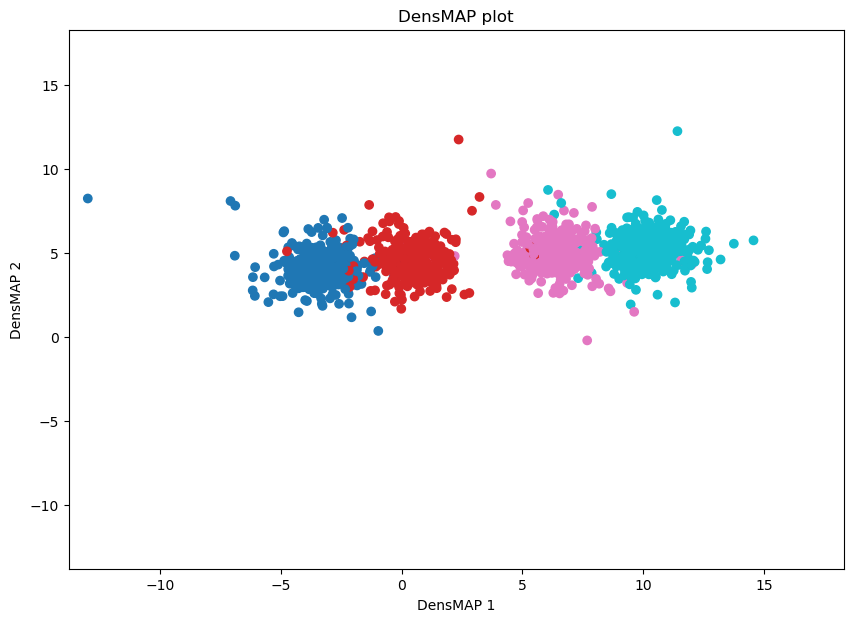
# DensMAP plot
import umap
emb_densmap = umap.UMAP(densmap=True).fit_transform(data)

adata.obsm['X_densmap'] = emb_densmap


# plot the data by DensMAP
plot_func(emb_densmap, data_pseudotime, 'DensMAP')
[32]:
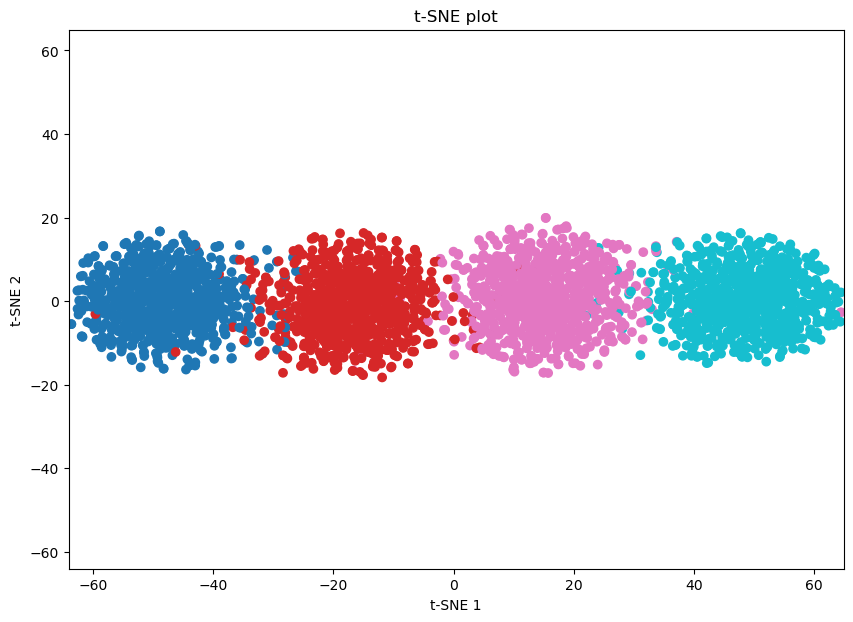
# plot the data by t-SNE
from sklearn.manifold import TSNE
emb_tsne = TSNE(n_components=2, random_state=42).fit_transform(data)

adata.obsm['X_tsne'] = emb_tsne

plot_func(emb_tsne, data_pseudotime, 't-SNE')
[ ]:
# you need to install the phate package
# !pip install --user phate
[33]:
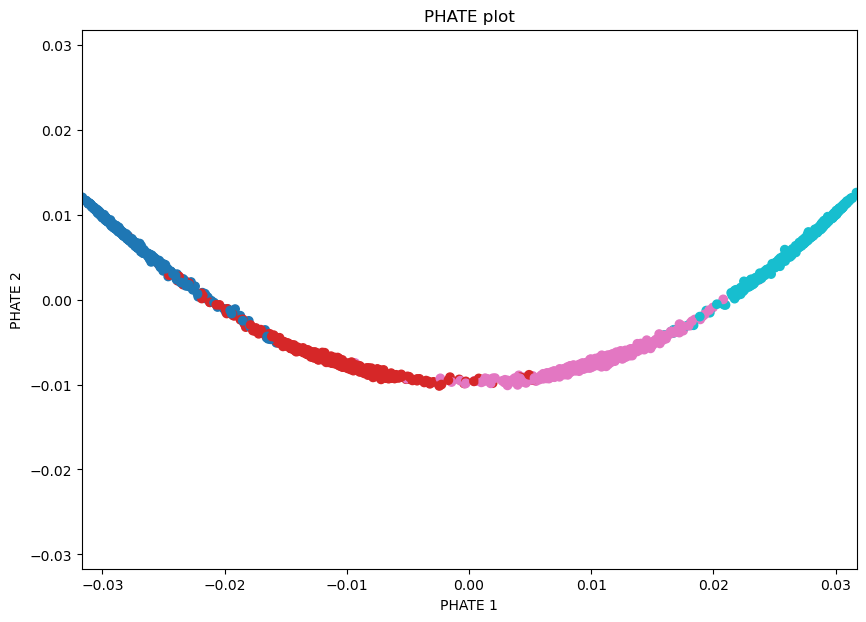
# plot the data by phate
import phate
phate_op = phate.PHATE()
emb_phate = phate_op.fit_transform(data)
adata.obsm['X_phate'] = emb_phate

plot_func(emb_phate, data_pseudotime, 'PHATE')
Calculating PHATE...
  Running PHATE on 3000 observations and 20 variables.
  Calculating graph and diffusion operator...
    Calculating KNN search...
    Calculated KNN search in 0.21 seconds.
    Calculating affinities...
    Calculated affinities in 0.01 seconds.
  Calculated graph and diffusion operator in 0.23 seconds.
  Calculating landmark operator...
    Calculating SVD...
    Calculated SVD in 0.32 seconds.
    Calculating KMeans...
    Calculated KMeans in 6.75 seconds.
  Calculated landmark operator in 7.86 seconds.
  Calculating optimal t...
    Automatically selected t = 10
  Calculated optimal t in 15.36 seconds.
  Calculating diffusion potential...
  Calculated diffusion potential in 15.28 seconds.
  Calculating metric MDS...
  Calculated metric MDS in 4.69 seconds.
Calculated PHATE in 43.42 seconds.
Get the PHATE graph
[34]:
emb_phate_obj = phate_op.fit(data)
phate_graph = emb_phate_obj.graph.to_igraph()
# number of nodes
print(phate_graph.vcount())


# to networkx
phate_graph_nx = phate_graph.to_networkx()
Running PHATE on 3000 observations and 20 variables.
Calculating graph and diffusion operator...
  Calculating KNN search...
  Calculated KNN search in 0.21 seconds.
  Calculating affinities...
  Calculated affinities in 0.01 seconds.
Calculated graph and diffusion operator in 0.23 seconds.
Calculating landmark operator...
  Calculating SVD...
  Calculated SVD in 0.30 seconds.
  Calculating KMeans...
  Calculated KMeans in 7.62 seconds.
Calculated landmark operator in 8.72 seconds.
3000
[35]:
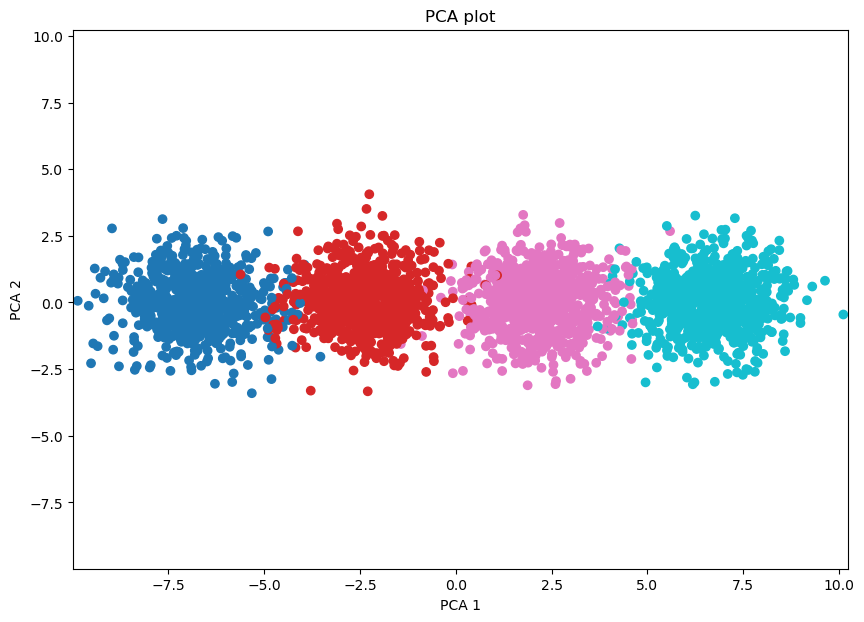
# plot data by PCA
pca = PCA(n_components=2)
X_pca = pca.fit_transform(data)

adata.obsm['X_pca'] = X_pca

plot_func(X_pca, data_pseudotime, 'PCA')
[36]:
from featuremap.features import feature_variation, feature_variation_embedding
feature_variation(adata, threshold=0.9)
k is 10
Start matrix multiplication
Finish matrix multiplication in 0.007294893264770508
Finish norm calculation in 0.002332925796508789
[37]:
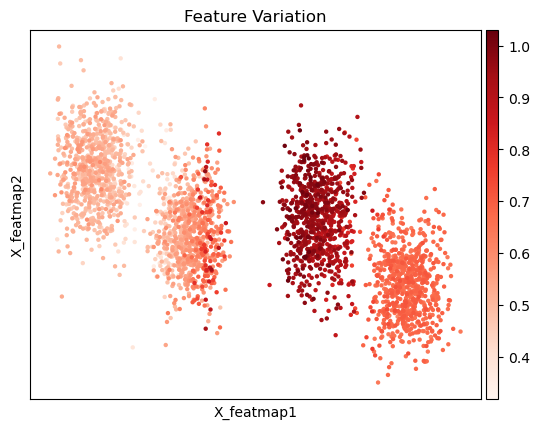
sc.pl.embedding(adata, basis='X_featmap', color='1' ,layer='variation_feature', title='Feature Variation', cmap='Reds')
Transition and core states identification by density, curvature and betweenness centrality.
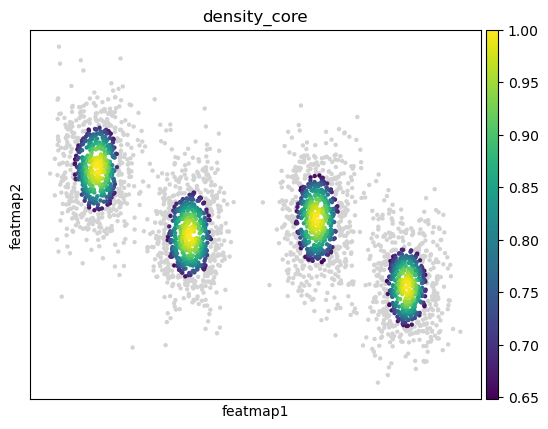
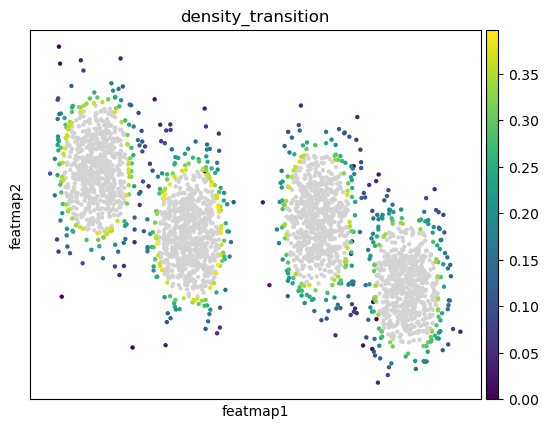
Use density to define transition and core states.
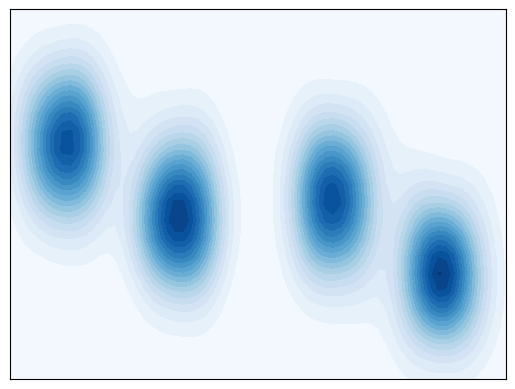
[38]:
##################################
# Contour plot to show the density
######################################
from featuremap import core_transition_states
import importlib
importlib.reload(core_transition_states)

from featuremap.core_transition_states import plot_density
plot_density(adata)


#%%
#######################################################
# Compute core-states based on clusters
#########################################################
quantile_core = 0.5
quantile_trans = 0.2


from featuremap.core_transition_states import compute_density
compute_density(adata, quantile_core=quantile_core, quantile_trans=quantile_trans)

# import scanpy as sc
# sc.pl.embedding(adata, basis='X_featmap_v', color='core_trans_states',  )
sc.pl.embedding(adata, 'featmap_v',legend_fontsize=6, s=10, legend_loc='on data', color='density')

# plot histogram of density
import seaborn as sns
import matplotlib.pyplot as plt

density = adata.obs['density']

plt.figure(dpi=100)
sns.histplot(density, bins=50)
plt.xlabel('Density')
plt.ylabel('Frequency')
plt.title('Histogram of Density')
threshold_core = density.quantile(quantile_core)
plt.axvline(threshold_core, color='red', linestyle='--', label='Core threshold')

threshold_trans = density.quantile(quantile_trans)
plt.axvline(threshold_trans, color='blue', linestyle='--', label='Transition threshold')
plt.legend()

plt.show()
<Figure size 640x480 with 0 Axes>
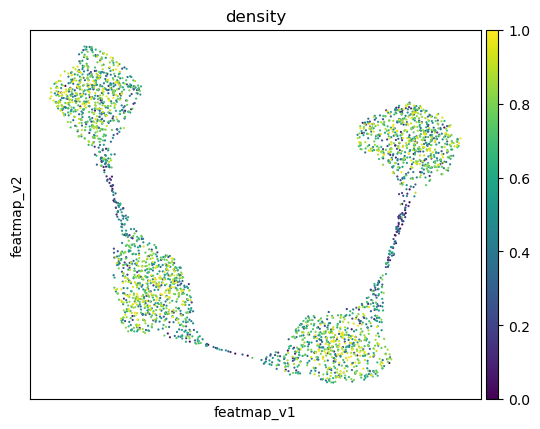
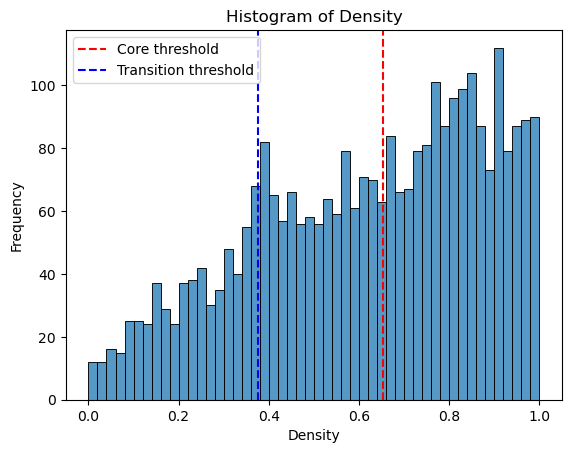
Use curvature to define transition and core states.
Curvature by variation
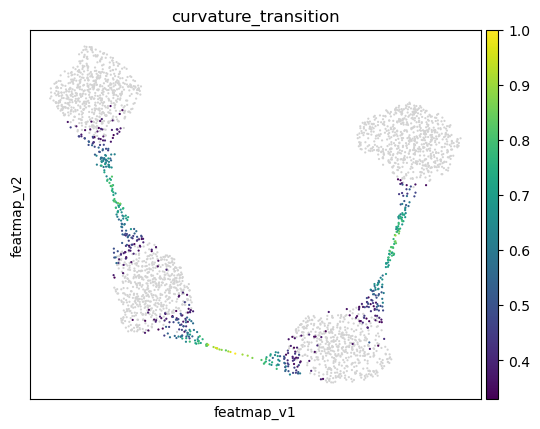
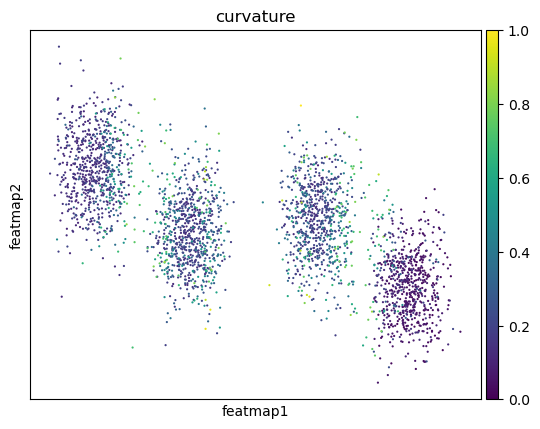
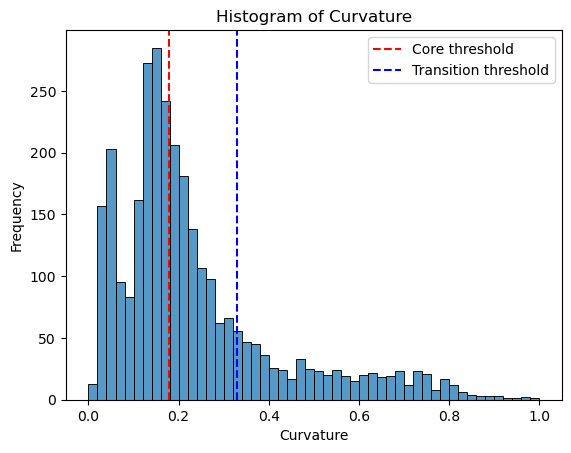
Consider a car driving along a curvy road. The tighter the curve, the more difficult the driving is. In math we have a number, the curvature, that describes this “tightness”. If the curvature is zero then the curve looks like a line near this point. While if the curvature is a large number, then the curve has a sharp bend.
[39]:
from featuremap import core_transition_states
import importlib
importlib.reload(core_transition_states)

quantile_core = 0.5
quantile_trans = 0.8
core_transition_states.compute_curvature(adata, emb_featuremap, quantile_core=quantile_core, quantile_trans=quantile_trans)

sc.pl.embedding(adata, 'featmap',legend_fontsize=6, s=10, legend_loc='on data', color='curvature')

# plot histogram of curvature
import seaborn as sns
import matplotlib.pyplot as plt

curvature = adata.obs['curvature']

plt.figure(dpi=100)
sns.histplot(curvature, bins=50)
plt.xlabel('Curvature')
plt.ylabel('Frequency')
plt.title('Histogram of Curvature')
threshold_core = curvature.quantile(quantile_core)
plt.axvline(threshold_core, color='red', linestyle='--', label=f'Core threshold')

threshold_trans = curvature.quantile(quantile_trans)
plt.axvline(threshold_trans, color='blue', linestyle='--', label=f'Transition threshold')
plt.legend()

plt.show()
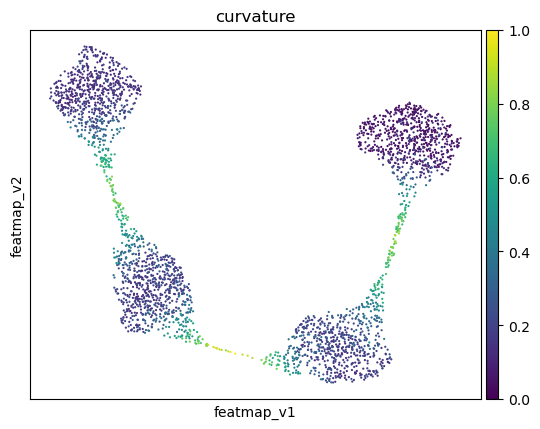
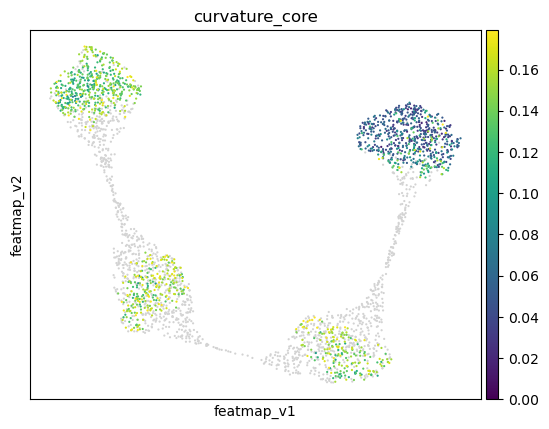
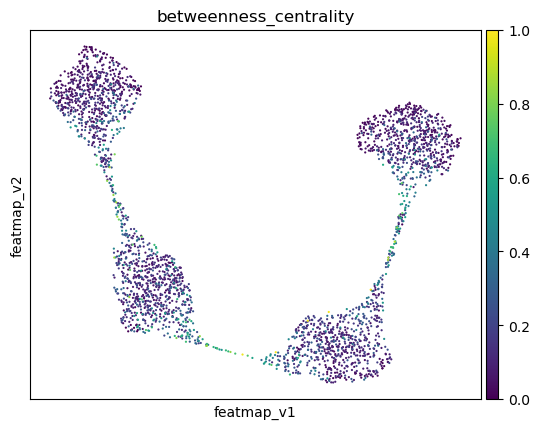
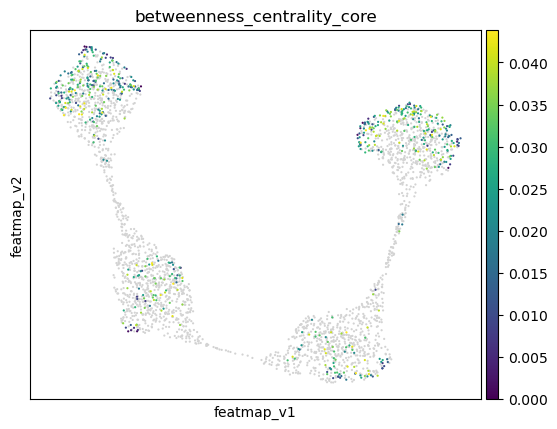
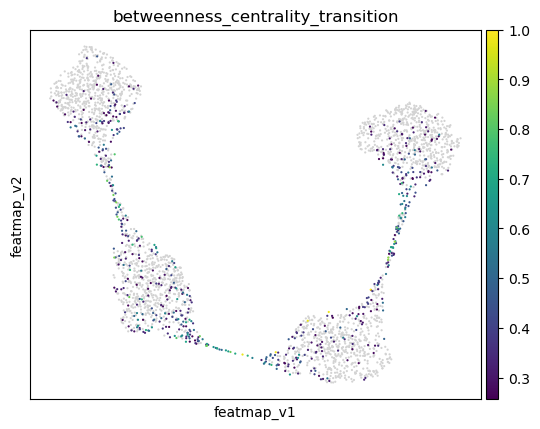
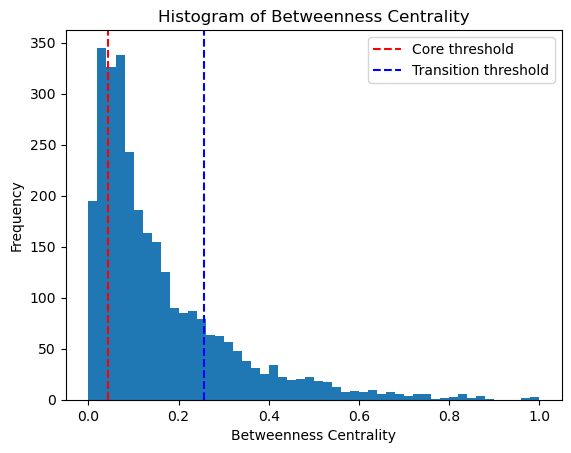
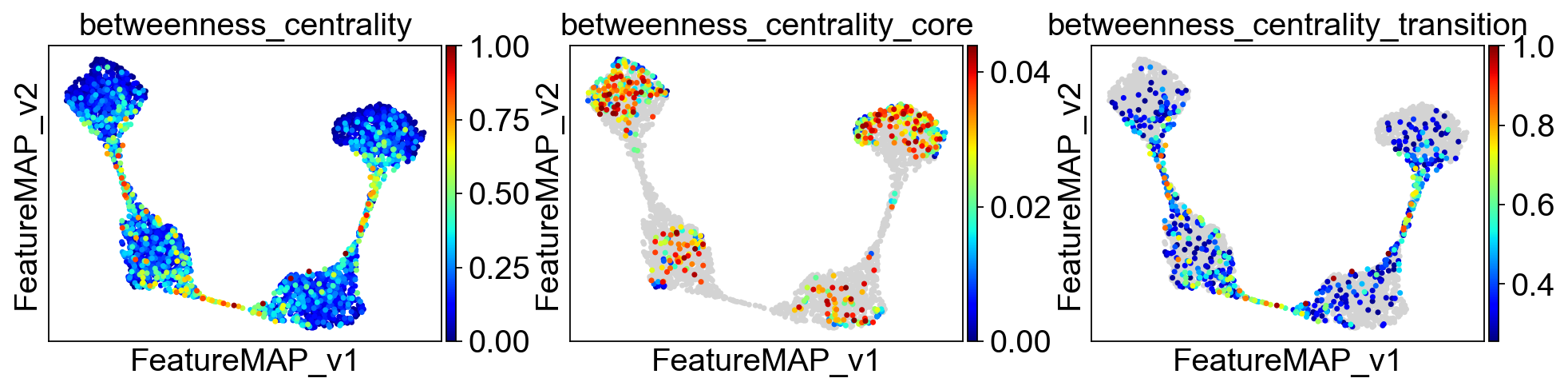
Use betweeness centrality to define transition states. Transition cells demostrates larger betweenness centrality.
[40]:
from featuremap import core_transition_states
import importlib
importlib.reload(core_transition_states)

quantile_trans = 0.8
quantile_core = 0.2


core_transition_states.compute_betweenness_centrality(adata, emb_featuremap, quantile_core=quantile_core, quantile_trans=quantile_trans)

betweenness_centrality = adata.obs['betweenness_centrality'].copy()
plt.hist(betweenness_centrality, bins=50)

threshold_core = betweenness_centrality.quantile(quantile_core)
plt.axvline(threshold_core, color='red', linestyle='--', label=f'Core threshold')

threshold_trans = betweenness_centrality.quantile(quantile_trans)
plt.axvline(threshold_trans, color='blue', linestyle='--', label=f'Transition threshold')
plt.legend()

plt.xlabel('Betweenness Centrality')
plt.ylabel('Frequency')
plt.title('Histogram of Betweenness Centrality')

plt.show()
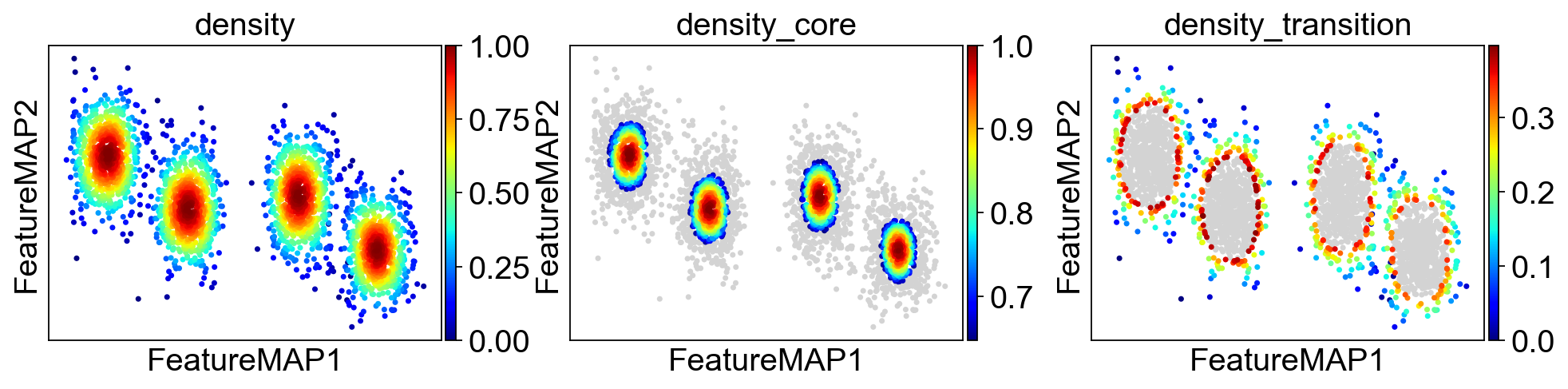
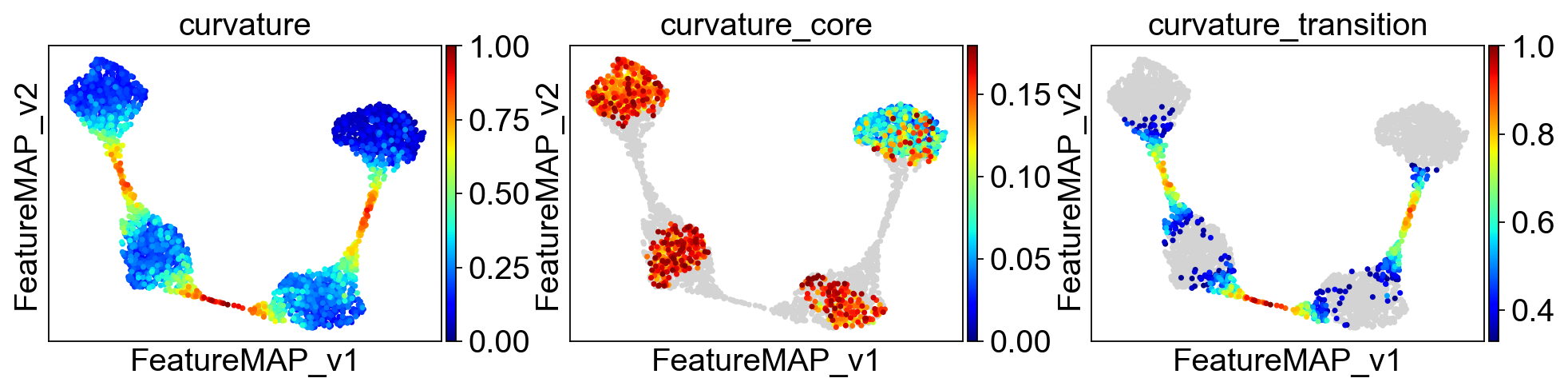
Visualize the results from density, curvature and betweenness centrality.
[41]:
adata.obsm['X_FeatureMAP'] = adata.obsm['X_featmap']
adata.obsm['X_FeatureMAP_v'] = adata.obsm['X_featmap_v']


# set figure size
sc.set_figure_params(figsize=(4, 3),fontsize=18)

sc.pl.embedding(adata, basis='FeatureMAP', color=['density', 'density_core', 'density_transition'], cmap='jet', save='_linear_density.png')
sc.pl.embedding(adata, basis='FeatureMAP_v', color=['curvature', 'curvature_core', 'curvature_transition'], cmap='jet', save='_linear_curvature.png')
sc.pl.embedding(adata, basis='FeatureMAP_v', color=['betweenness_centrality', 'betweenness_centrality_core', 'betweenness_centrality_transition'],
                cmap='jet',save='_linear_betweenness_centrality.png')
WARNING: saving figure to file figures/FeatureMAP_linear_density.png
WARNING: saving figure to file figures/FeatureMAP_v_linear_curvature.png
WARNING: saving figure to file figures/FeatureMAP_v_linear_betweenness_centrality.png
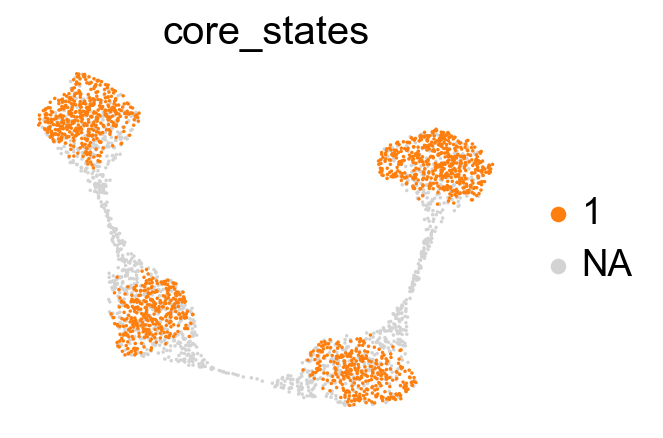
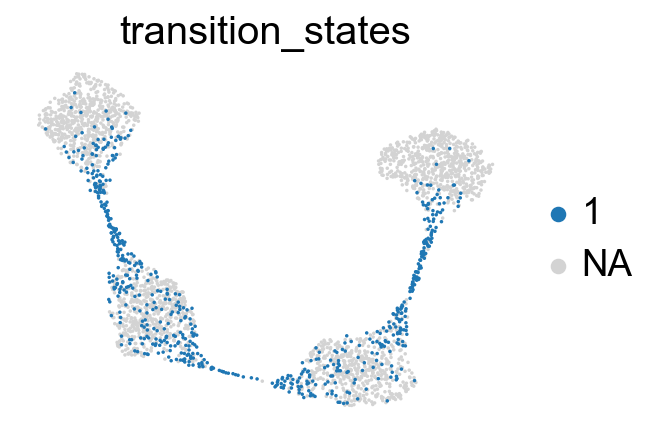
Union the results for transition and core states by density, curvature and betweenness centrality.
[42]:
from featuremap import core_transition_states
import importlib
importlib.reload(core_transition_states)
core_transition_states.plot_core_transition_states(adata)
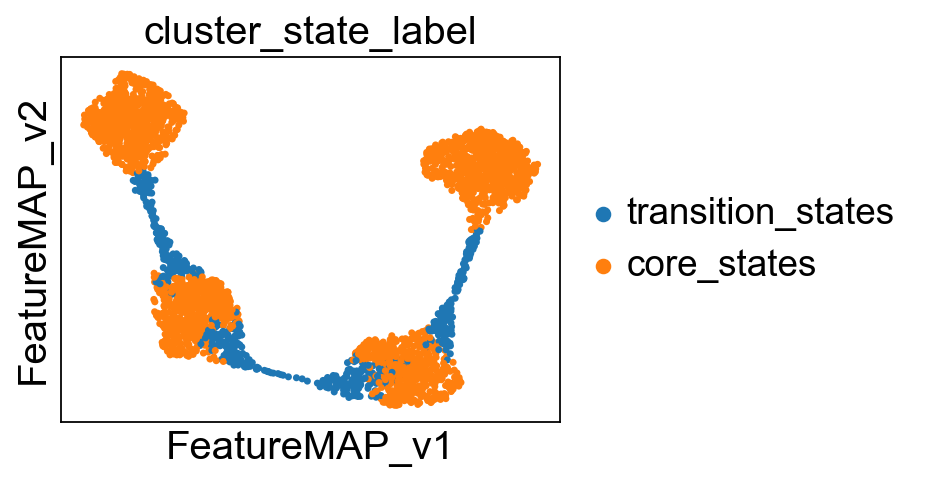
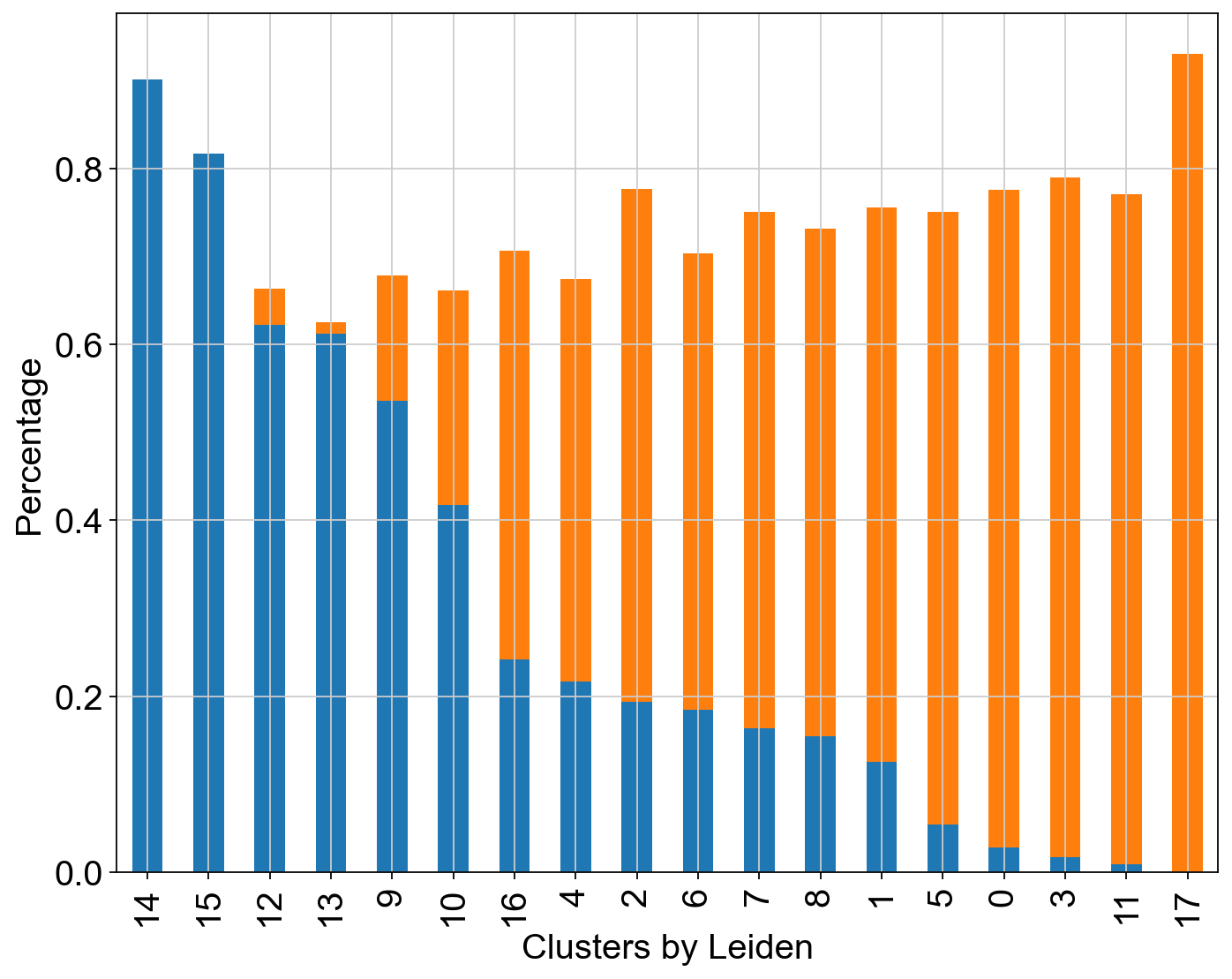
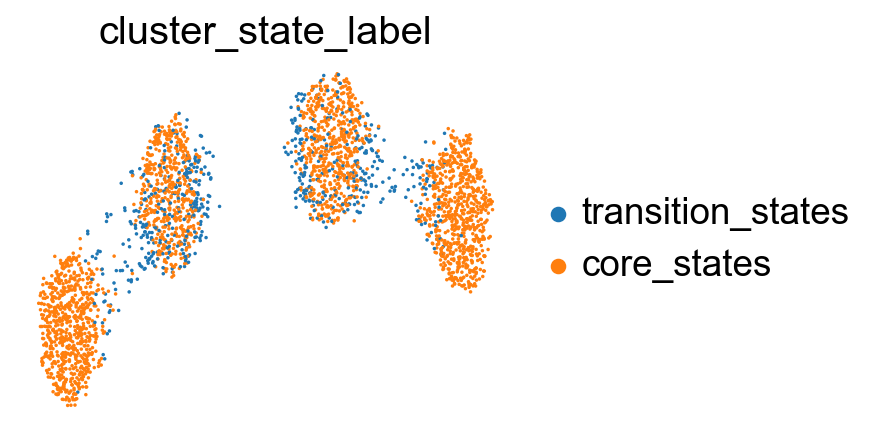
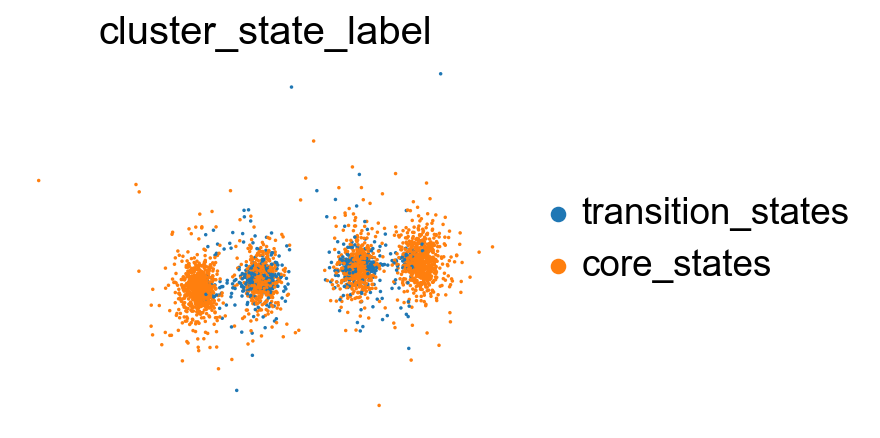
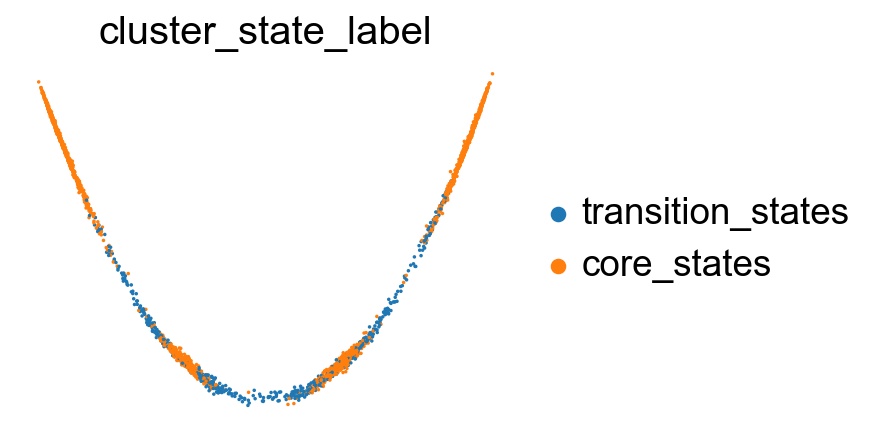
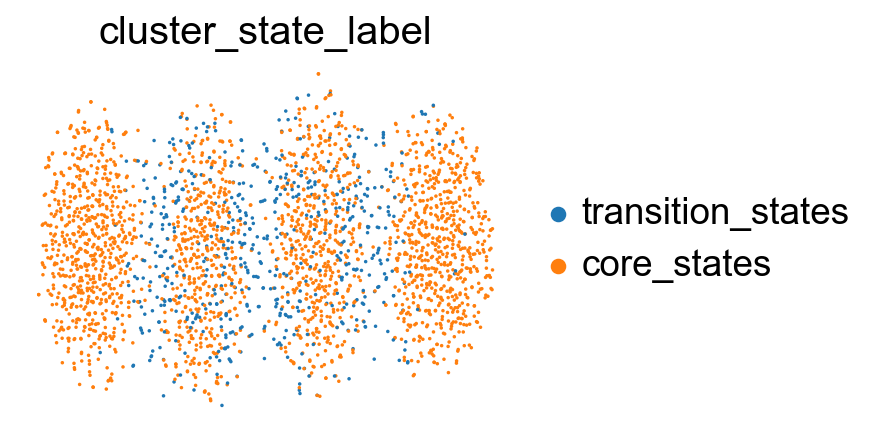
Compute the cluster state labels based on the percentage of core_states and transition_states for each cluster.
[43]:
import anndata as ad
adata_var = ad.AnnData(X=adata.obsm['variation_pc'], obs=adata.obs)
adata_var.obsm['X_featmap_v'] = adata.obsm['X_featmap_v']
# adata_var.obs['clusters'] = adata.obs['clusters']

# leiiden clustering on variation embedding
sc.pp.pca(adata_var)
sc.pp.neighbors(adata_var, n_neighbors=5,)
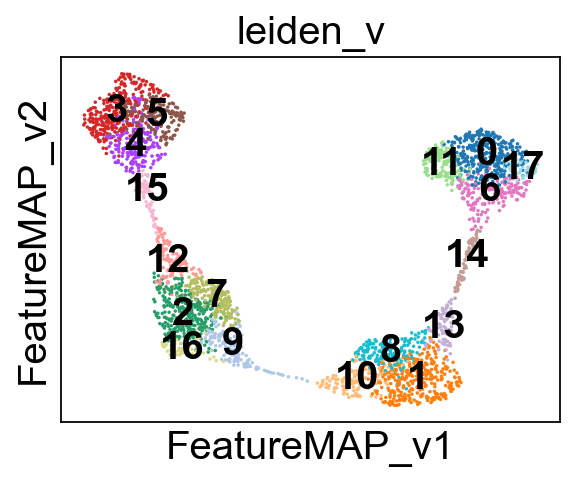
sc.tl.leiden(adata_var, resolution=0.8)
adata.obs['leiden_v'] = adata_var.obs['leiden']

sc.pl.embedding(adata, basis='FeatureMAP_v', color='leiden_v', legend_loc='on data', s=10)

from featuremap import core_transition_states

import importlib
importlib.reload(core_transition_states)

core_transition_states.compute_cluster_state_labels(adata)
[44]:
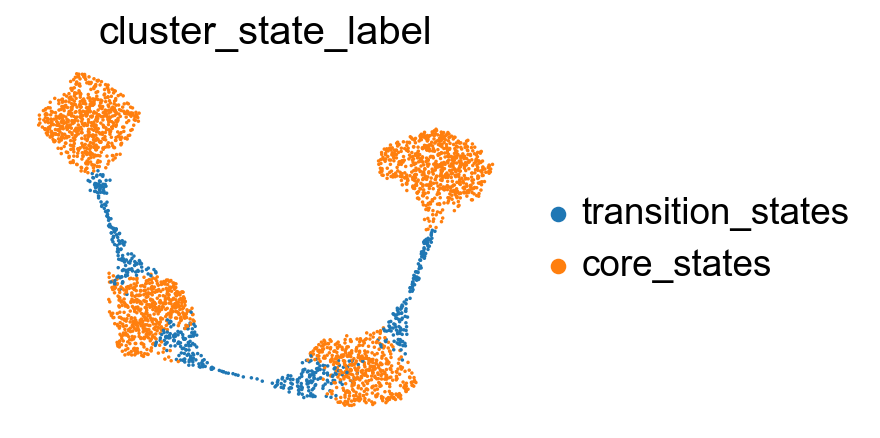
# visualize cluster_state_label in UMAP, DensMAP, PHATE, t-SNE, PCA
sc.pl.embedding(adata, basis='X_featmap_v', color='cluster_state_label', cmap='Blues_r', s=10, frameon=False)
sc.pl.embedding(adata, basis='X_umap', color='cluster_state_label', cmap='Blues_r', s=10, frameon=False)
sc.pl.embedding(adata, basis='X_densmap', color='cluster_state_label', cmap='Blues_r', s=10, frameon=False)
sc.pl.embedding(adata, basis='X_phate', color='cluster_state_label', cmap='Blues_r', s=10,  frameon=False)
sc.pl.embedding(adata, basis='X_tsne', color='cluster_state_label', cmap='Blues_r', s=10, frameon=False)
sc.pl.embedding(adata, basis='X_pca', color='cluster_state_label', cmap='Blues_r', s=10,frameon=False)
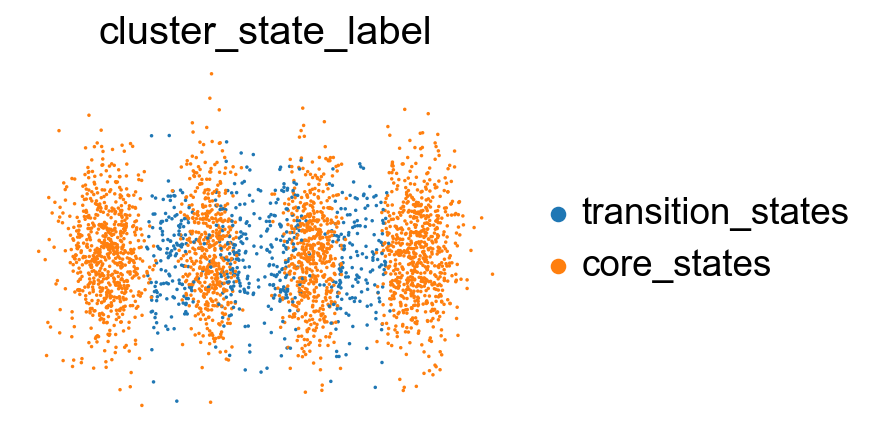
Project the identified transition and core states back to the original data
[45]:
X_pca = adata.obsm['X_pca']

x_min, x_max = X_pca[:, 0].min() - 1, X_pca[:, 0].max() + 1
y_min, y_max = X_pca[:, 1].min() - 1, X_pca[:, 1].max() + 1

min_lim = min(x_min, y_min)
max_lim = max(x_max, y_max)

# contour plot of the data
import numpy as np
import matplotlib.pyplot as plt
from sklearn.neighbors import KernelDensity

# Create a grid of points
x = np.linspace(min_lim, max_lim, 100)
y = np.linspace(min_lim, max_lim, 100)
X, Y = np.meshgrid(x, y)
# Stack the grid points to create a 2D input for the KDE model
xy = np.vstack([X.ravel(), Y.ravel()]).T

# Fit a KDE model to the data
kde = KernelDensity(bandwidth=0.5)
kde.fit(X_pca)

# Evaluate the KDE model on the grid
Z = np.exp(kde.score_samples(xy))
Z = Z.reshape(X.shape)

color = adata.obs['cluster_state_label'].cat.codes

# create color map by [#1f77b4, #ff7f0e]
from matplotlib.colors import ListedColormap
cmap = ListedColormap(['#1f77b4', '#ff7f0e'])


# Plot the contour plot
plt.figure(figsize=(10, 7))
plt.contourf(X, Y, Z,levels=15, cmap='Blues',linewidths=0.5, )

# Add lines to mark level boundaries
contour_lines = plt.contour(X, Y, Z, levels=15, colors='blue', linewidths=0.5)

# plt.colorbar()
plt.scatter(X_pca[:, 0], X_pca[:, 1], c=color, cmap=cmap, alpha=0.2)
plt.xlim(min_lim, max_lim)
plt.ylim(min_lim, max_lim)
plt.xlabel('First principal component')
plt.ylabel('Second principal component')
plt.title('Contour plot of the data')
plt.show()
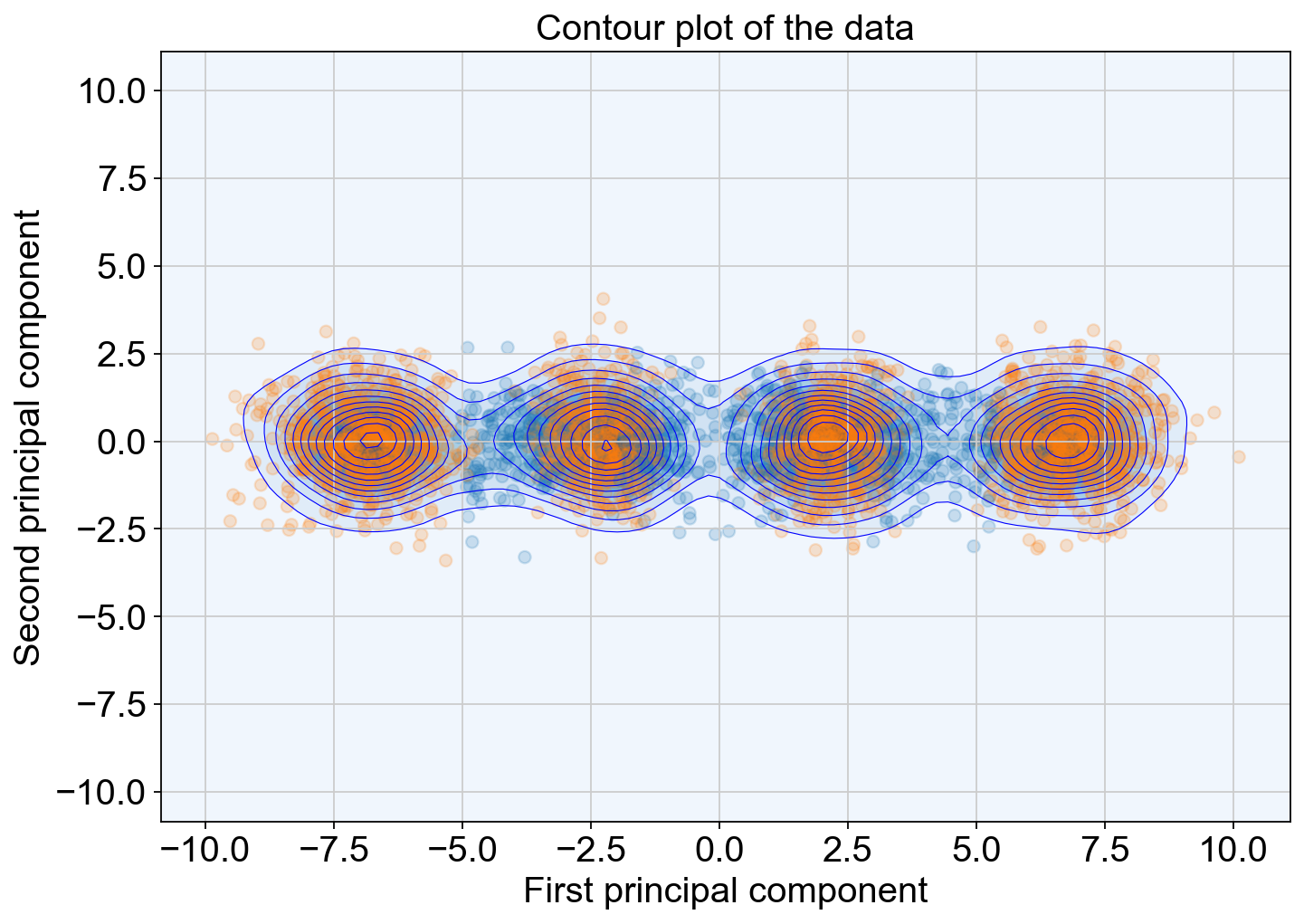
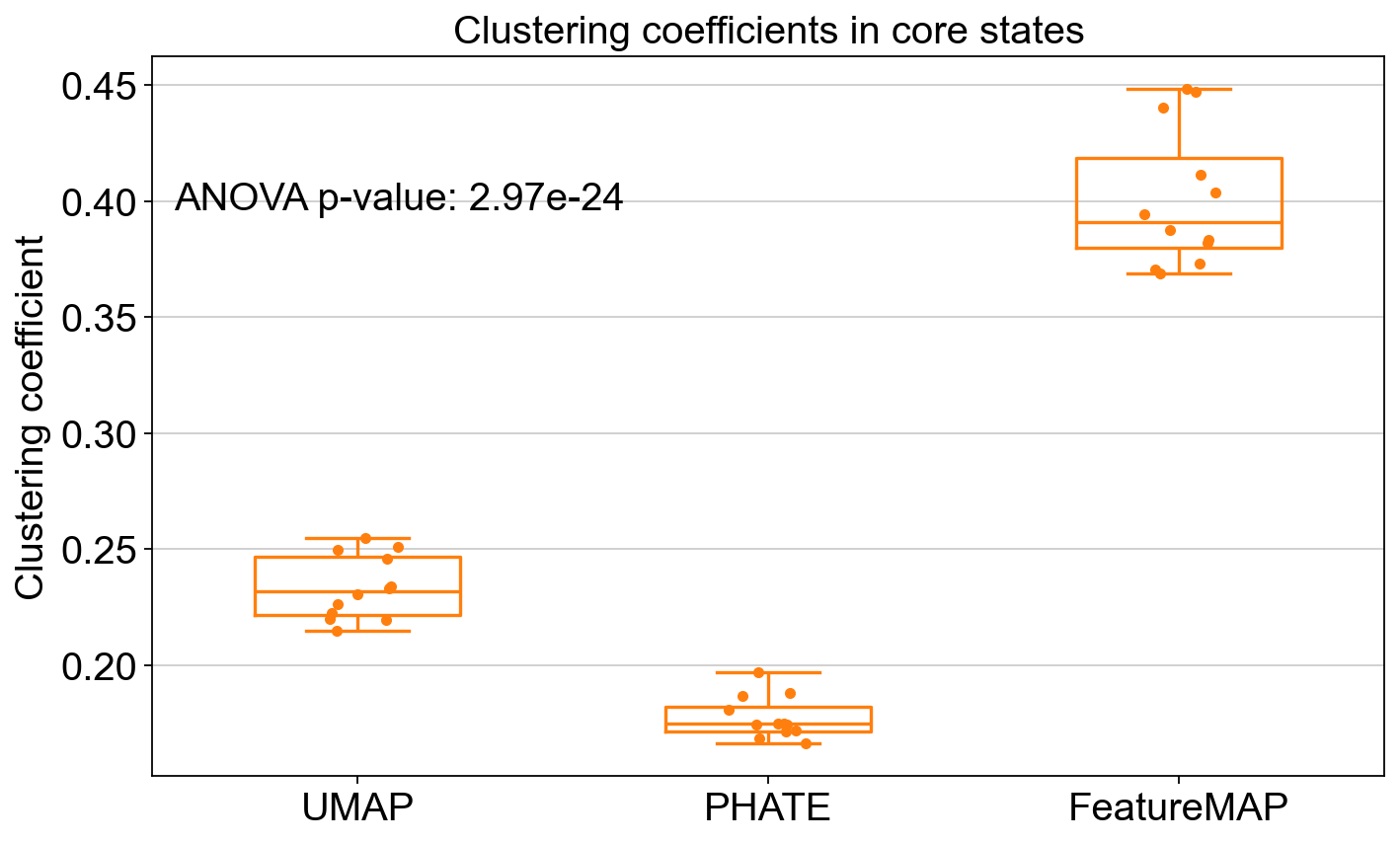
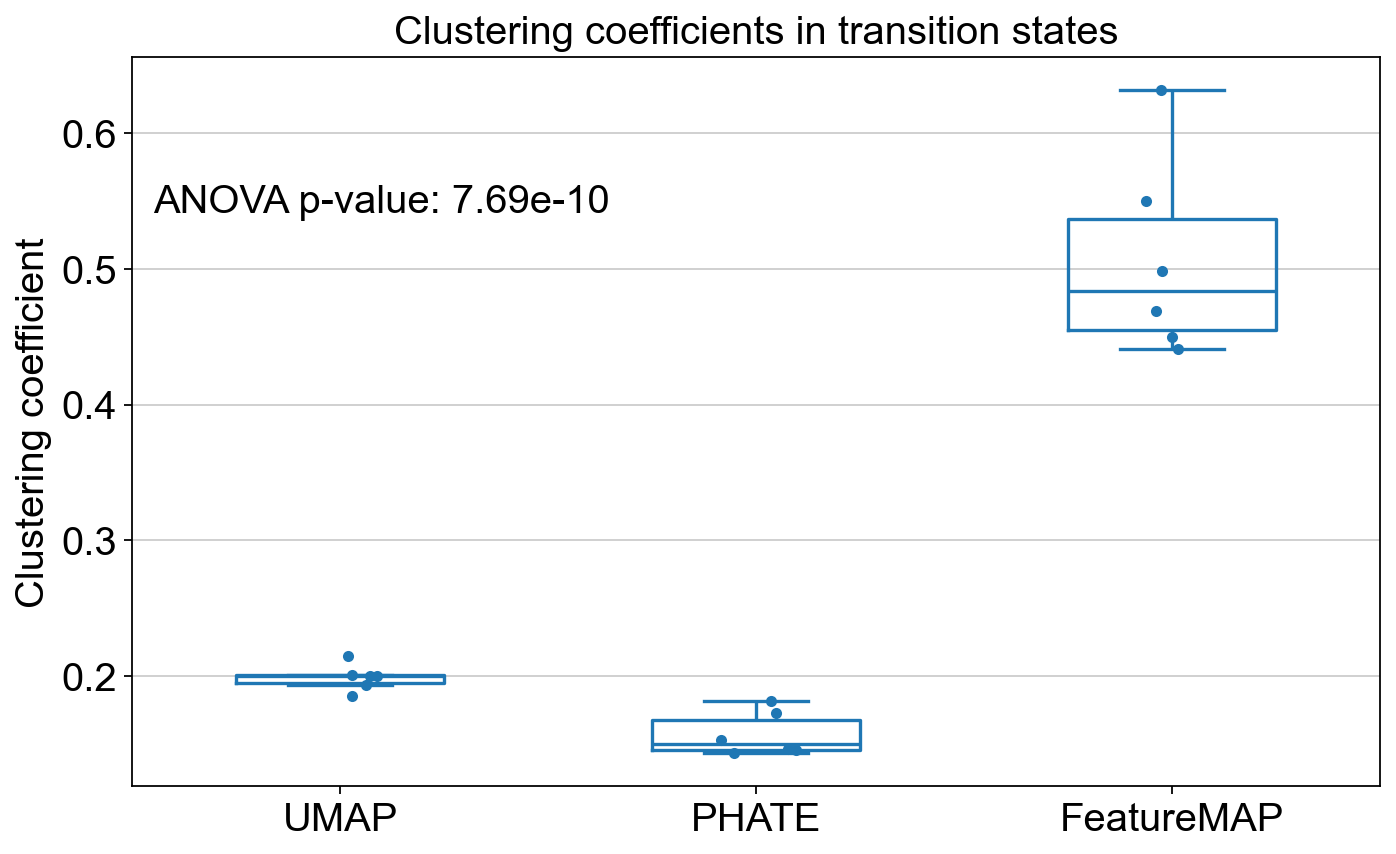
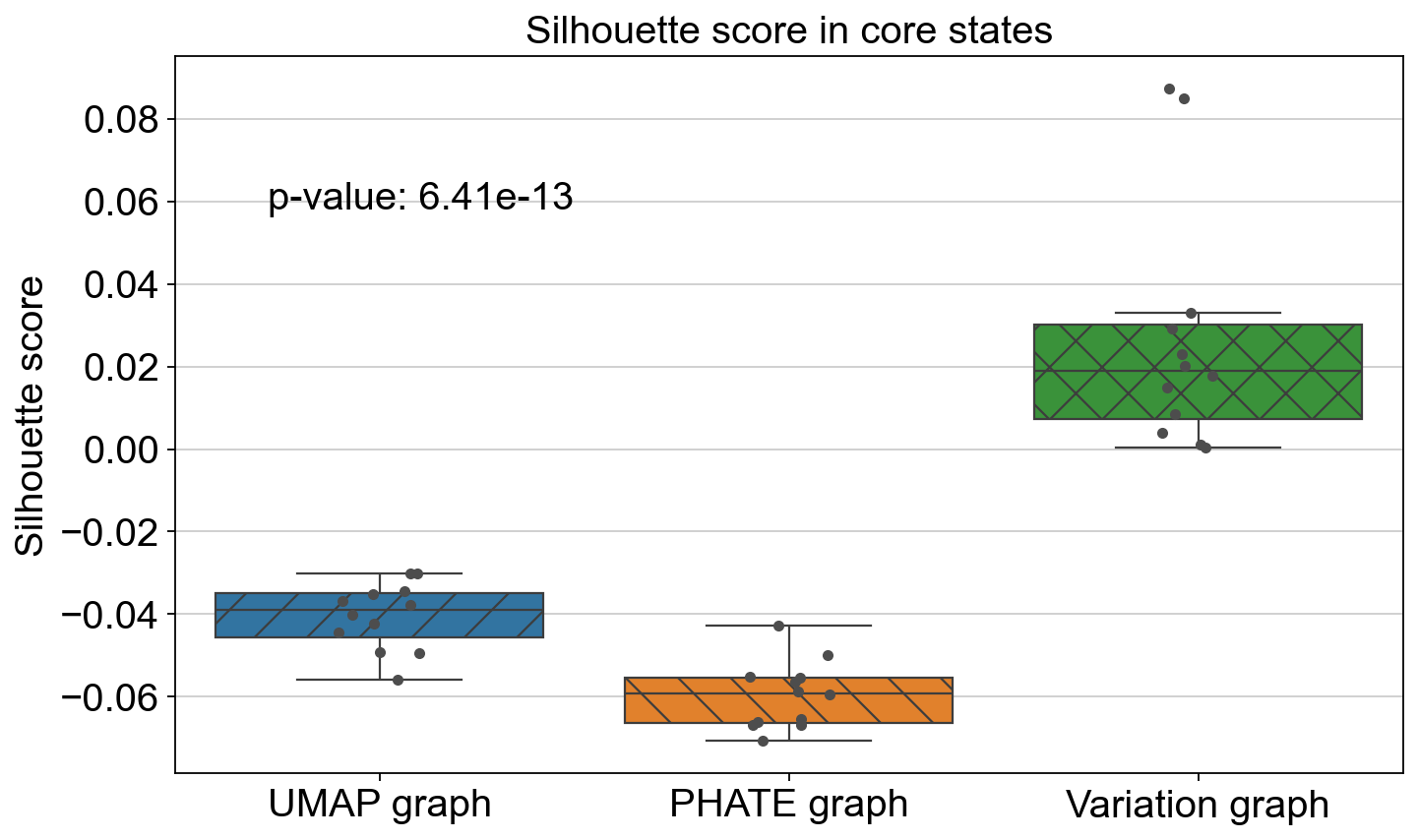
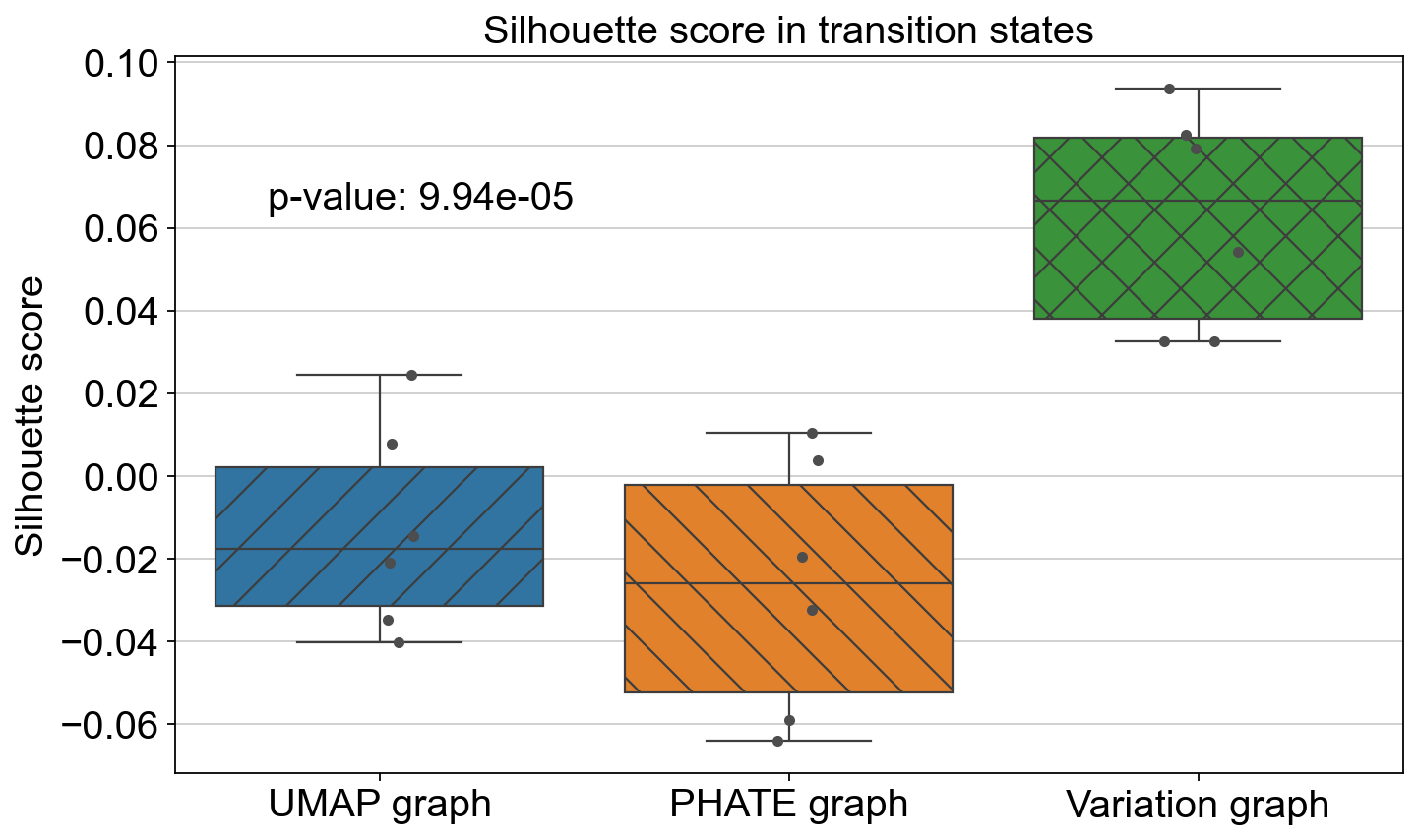
FeatureMAP better shows the transition and core states than other methods in terms of clustering coefficients and Silhouette scores.
Compare the clustering coefficient in clustersing by UMAP, PHATE and FeatureMAP.
[46]:
from featuremap import core_transition_states
import importlib
import networkx as nx
import pandas as pd
import seaborn as sns
import matplotlib.pyplot as plt
from scipy.stats import ttest_ind, f_oneway

importlib.reload(core_transition_states)

# Create graphs from feature maps
G_expr = nx.from_numpy_matrix(emb_featuremap.graph_)
G_var = nx.from_numpy_matrix(emb_featuremap_v._featuremap_kwds['graph_v'])
G_phate = phate_graph_nx

# Get clusters
clusters = adata.obs['leiden_v'].values.tolist()

# Compute weighted clustering coefficients
cluster_coefficients_var = core_transition_states.clustering_coefficient_by_cluster(G_var, clusters)
cluster_coefficients_expr = core_transition_states.clustering_coefficient_by_cluster(G_expr, clusters)
cluster_coefficients_phate = core_transition_states.clustering_coefficient_by_cluster(G_phate, clusters)

# Create DataFrames
df_var = pd.DataFrame({"Cluster": list(cluster_coefficients_var.keys()), "Coefficient": list(cluster_coefficients_var.values()), "type": 'variation_graph'})
df_expr = pd.DataFrame({"Cluster": list(cluster_coefficients_expr.keys()), "Coefficient": list(cluster_coefficients_expr.values()), "type": 'expression_graph'})
df_phate = pd.DataFrame({"Cluster": list(cluster_coefficients_phate.keys()), "Coefficient": list(cluster_coefficients_phate.values()), "type": 'phate_graph'})

# Combine DataFrames
coeff_all = []

# Helper function to append coefficients
def append_coefficients(state_type, cluster_coefficients):
    cluster_state_dict = adata.uns['cluster_state_dict']
    states = [cluster for cluster, state in cluster_state_dict.items() if state == state_type]
    return [cluster_coefficients[cluster] for cluster in states]

# Append coefficients for transition and core states
coeff_all.append(append_coefficients('transition_states', cluster_coefficients_expr))
coeff_all.append(append_coefficients('core_states', cluster_coefficients_expr))
coeff_all.append(append_coefficients('transition_states', cluster_coefficients_phate))
coeff_all.append(append_coefficients('core_states', cluster_coefficients_phate))
coeff_all.append(append_coefficients('transition_states', cluster_coefficients_var))
coeff_all.append(append_coefficients('core_states', cluster_coefficients_var))

# Core states coefficients
coeff_core_var = append_coefficients('core_states', cluster_coefficients_var)
coeff_core_expr = append_coefficients('core_states', cluster_coefficients_expr)
coeff_core_phate = append_coefficients('core_states', cluster_coefficients_phate)

# T-test and ANOVA
t_stat, p_val = ttest_ind(coeff_core_var, coeff_core_expr)
print(f'T-test: t_stat: {t_stat}, p_val: {p_val}')
f_stat, p_val = f_oneway(coeff_core_expr, coeff_core_phate, coeff_core_var)
print(f'ANOVA: f_stat: {f_stat}, p_val: {p_val}')


hatch_patterns = ['/','/', '\\','\\', 'x','x']  # Define hatch styles
# Plot core states
plt.figure(figsize=(10, 6))
box = sns.boxplot(data=[coeff_core_expr, coeff_core_phate, coeff_core_var], color=plt.get_cmap('tab10')(1), fill=False, width=0.5, showfliers=False)
for patch, hatch in zip(box.patches, hatch_patterns):
    patch.set_hatch(hatch)
sns.stripplot(data=[coeff_core_expr, coeff_core_phate, coeff_core_var], color=plt.get_cmap('tab10')(1), jitter=True, dodge=True)
plt.xticks(ticks=[0, 1, 2], labels=['UMAP', 'PHATE', 'FeatureMAP'])
plt.title("Clustering coefficients in core states")
plt.ylabel("Clustering coefficient")
plt.text(0.2, 0.8, f"ANOVA p-value: {p_val:.2e}", ha='center', va='center', transform=plt.gca().transAxes)
plt.show()

# Transition states coefficients
coeff_trans_var = append_coefficients('transition_states', cluster_coefficients_var)
coeff_trans_expr = append_coefficients('transition_states', cluster_coefficients_expr)
coeff_trans_phate = append_coefficients('transition_states', cluster_coefficients_phate)

# ANOVA for transition states
f_stat, p_val = f_oneway(coeff_trans_expr, coeff_trans_phate, coeff_trans_var)
print(f'ANOVA: f_stat: {f_stat}, p_val: {p_val}')

# Plot transition states
plt.figure(figsize=(10, 6))
box = sns.boxplot(data=[coeff_trans_expr, coeff_trans_phate, coeff_trans_var], color=plt.get_cmap('tab10')(0), fill=False, width=0.5, showfliers=False)
for patch, hatch in zip(box.patches, hatch_patterns):
    patch.set_hatch(hatch)
sns.stripplot(data=[coeff_trans_expr, coeff_trans_phate, coeff_trans_var], color=plt.get_cmap('tab10')(0), jitter=True, dodge=True)
plt.xticks(ticks=[0, 1, 2], labels=['UMAP', 'PHATE', 'FeatureMAP'])
plt.title("Clustering coefficients in transition states")
plt.ylabel("Clustering coefficient")
plt.text(0.2, 0.8, f"ANOVA p-value: {p_val:.2e}", ha='center', va='center', transform=plt.gca().transAxes)
plt.show()
T-test: t_stat: 17.743922963991636, p_val: 1.5999205446236708e-14
ANOVA: f_stat: 423.40375124357513, p_val: 2.972238123489477e-24
ANOVA: f_stat: 115.60472442271464, p_val: 7.689517210395239e-10
Compare the Silhouette scores in clustersing by UMAP, PHATE and FeatureMAP.
[48]:
import networkx as nx
from featuremap import core_transition_states
import importlib
importlib.reload(core_transition_states)
from sklearn.metrics import pairwise_distances, silhouette_score
from scipy.stats import ttest_ind, f_oneway
import matplotlib.pyplot as plt
import seaborn as sns

# Graph distance matrices
G_expr = nx.from_numpy_matrix(emb_featuremap.graph_)
G_var = nx.from_numpy_matrix(emb_featuremap_v._featuremap_kwds['graph_v'])
G_phate = phate_graph_nx

# Get the weighted adjacency matrix
adjacency_expr = nx.to_numpy_array(G_expr)
adjacency_var = nx.to_numpy_array(G_var)
adjacency_phate = nx.to_numpy_array(G_phate)

# Compute the distance matrices
dist_mat_expr = pairwise_distances(adjacency_expr, metric='euclidean')
dist_mat_var = pairwise_distances(adjacency_var, metric='euclidean')
dist_mat_phate = pairwise_distances(adjacency_phate, metric='euclidean')

labels = np.array(adata.obs['leiden_v'].values.tolist())
clusters = np.unique(labels)

ss_clusters_expr, ss_clusters_var, ss_clusters_phate = {}, {}, {}

for cluster in clusters:
    cluster_indices = np.where(labels == cluster)[0]
    ss_clusters_expr[cluster] = np.mean([core_transition_states.silhouette_score_one_point(dist_mat_expr, labels, idx) for idx in cluster_indices])
    ss_clusters_var[cluster] = np.mean([core_transition_states.silhouette_score_one_point(dist_mat_var, labels, idx) for idx in cluster_indices])
    ss_clusters_phate[cluster] = np.mean([core_transition_states.silhouette_score_one_point(dist_mat_phate, labels, idx) for idx in cluster_indices])

ss_all = []

def compute_silhouette_scores(state_type, ss_clusters):
    cluster_state_dict = adata.uns['cluster_state_dict']
    states = [cluster for cluster, state in cluster_state_dict.items() if state == state_type]
    return [ss_clusters[cluster] for cluster in states]

ss_all.append(compute_silhouette_scores('transition_states', ss_clusters_expr))
ss_all.append(compute_silhouette_scores('core_states', ss_clusters_expr))

ss_all.append(compute_silhouette_scores('transition_states', ss_clusters_phate))
ss_all.append(compute_silhouette_scores('core_states', ss_clusters_phate))

ss_all.append(compute_silhouette_scores('transition_states', ss_clusters_var))
ss_all.append(compute_silhouette_scores('core_states', ss_clusters_var))

# T-test and ANOVA

f_stat_1, p_val_1 = f_oneway(ss_all[1], ss_all[3], ss_all[5])
print(f'ANOVA: f_stat: {f_stat}, p_val: {p_val}')

f_stat_2, p_val_2 = f_oneway(ss_all[0], ss_all[2], ss_all[4])
print(f'ANOVA: f_stat: {f_stat}, p_val: {p_val}')


# Plotting
def plot_silhouette_scores(data, labels, title, p_val):
    plt.figure(figsize=(10, 6))
    box = sns.boxplot(data=data, palette="tab10", showfliers=False)
    hatch_patterns = ['/', '\\', 'x']
    for patch, hatch in zip(box.patches, hatch_patterns):
        patch.set_hatch(hatch)
    sns.stripplot(data=data, color=".3", jitter=True, dodge=True)
    plt.xticks(ticks=range(len(labels)), labels=labels)
    plt.title(title)
    plt.ylabel("Silhouette score")
    plt.text(0.2, 0.8, f"p-value: {p_val:.2e}", ha='center', va='center', transform=plt.gca().transAxes)
    plt.show()

plot_silhouette_scores([ss_all[1], ss_all[3], ss_all[5]], ['UMAP graph', 'PHATE graph', 'Variation graph'], "Silhouette score in core states", p_val_1)
plot_silhouette_scores([ss_all[0], ss_all[2], ss_all[4]], ['UMAP graph', 'PHATE graph', 'Variation graph'], "Silhouette score in transition states", p_val_2)
ANOVA: f_stat: 11.07845869758166, p_val: 0.0005191265280032587
ANOVA: f_stat: 11.07845869758166, p_val: 0.0005191265280032587
[ ]: